Mysteries
In this section I want to address some of the mysteries still surrounding the Parker/Hulme case.For now:
◦ Did Juliet have a diary?
Examine the evidence and judge for yourself.
◦ The Great Mystery
What's with Pauline's chin in those pictures?
◦ Plasticine horses.
Did Pauline and Juliet actually do plasticine/clay modeling?
◦ The strange case of Alison J. Laurie and Hilary Nathan
Wait .... WHAT???
The strange case of Alison J. Laurie and Hilary Nathan
I will argue that the lives of Alison Laurie (one of the writers of the 1991 book 'Parker & Hulme: a lesbian view') and Hilary Nathan (Pauline Parker) are more intertwined than commonly assumed. All sources bottom of article.
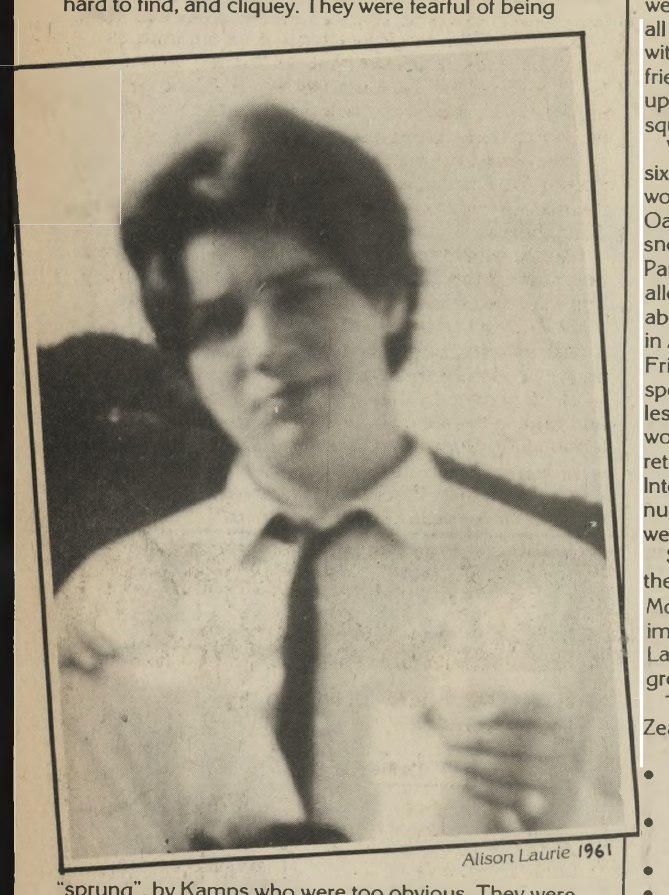 The 1954 Parker-Hulme murder case remains one of New Zealand’s most notorious true-crime stories. For decades, mainstream narratives focused heavily on the sensationalized psychological isolation of the two teenage girls. However, a deeper examination of post-war queer history reveals a startling, hidden parallel between the foremost historian of the case, Dr. Alison J. Laurie, and one of its perpetrators, Pauline Parker—later known as Hilary Nathan. When mapping their lifetimes against the clandestine networks of the mid-20th-century lesbian underground, it becomes highly probable that these two women did not merely share a homeland, but actively crossed paths in the tiny, insular Auckland "Kamp" scene of the early 1960s, setting off a chain of events where Nathan directly followed in Laurie’s footsteps to London.
To understand how their lives intersected, one must look at the unique topography of New Zealand’s underground homosexual subculture at the time. Following her release from prison in late 1959, Pauline Parker was placed under strict parole conditions that monitored her movements and associations. Adopting the deeply symbolic alias Hilary Nathan—an echo of the biblical prophet Nathan who confronted King David over a hidden murder—she quietly sought to rebuild her life. She enrolled at Auckland University, graduating with a Bachelor of Arts in 1964. Concurrently, a young Alison Laurie was navigating the very same city. As Laurie later documented in her personal histories for Broadsheet magazine, the New Zealand lesbian community of the early 1960s was minuscule. By late 1964, the entire known, active lesbian scene in Auckland amounted to just twenty-five women.
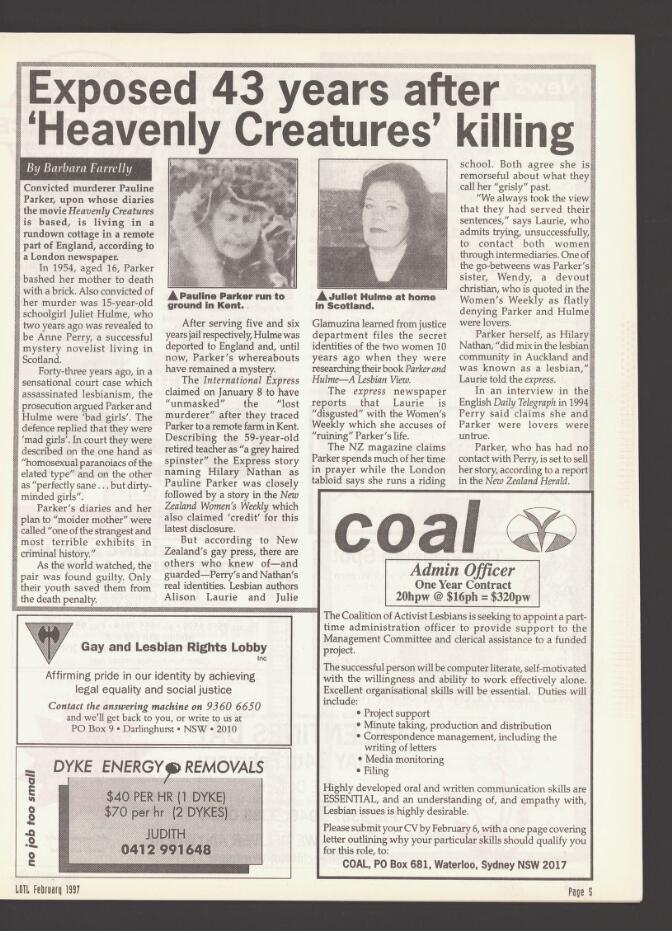 Within such a microscopic and protective social circle, anonymity was impossible. It is highly unlikely that an educational transplant like Hilary Nathan and an active, visible seeker of community like Alison Laurie remained unaware of each other. This is explicitly supported by Laurie’s own post-unmasking testimonies, where she noted that despite the shadow of parole, Nathan did indeed mix within the informal Auckland lesbian community and was recognized as a lesbian by her peers. Bound by a strict subcultural code of absolute loyalty, silence, and mutual protection against police harassment, this tight-knit group of twenty-five women formed a sanctuary where Nathan’s dark past was buried beneath a collective shield of discretion.
This shared environment directly facilitated what happened next: the transnational pipeline to exile. Disillusioned by the oppressive social climate and legal hostility of New Zealand, Alison Laurie boarded the Castel Felice in late 1964, bound for the relative freedom of London. In a striking mirror image, Hilary Nathan permanently left New Zealand for London in the exact same year, 1965. For a high-profile, closely monitored parolee like Nathan to successfully slip into the United Kingdom and immediately find her footing, she required a warm, trusted network.
She found it by directly following Laurie’s trajectory. Upon arriving in London, Laurie had immediately thrown herself into the Minorities Research Group (MRG) and helped distribute the lesbian publication Arena Three. When a faction broke away in 1965 to form Kenric—a democratic social organization co-founded by Julie Switsur to provide safe spaces for closeted women—the pipeline for Commonwealth expatriates was fully operational. Hilary Nathan did not stumble into this underground infrastructure by accident. She was ushered directly into it. By 1966, a mere year after her arrival, Nathan rose to become the National Chair of Kenric. It was through this very network that Nathan adopted the survival strategies—such as changing names via deed poll to secure domestic mortgages—that allowed her and her lifelong partner, Joan Nathan, to live invisibly as respected special education teachers at Abbey Court School in Kent for the next thirty years.
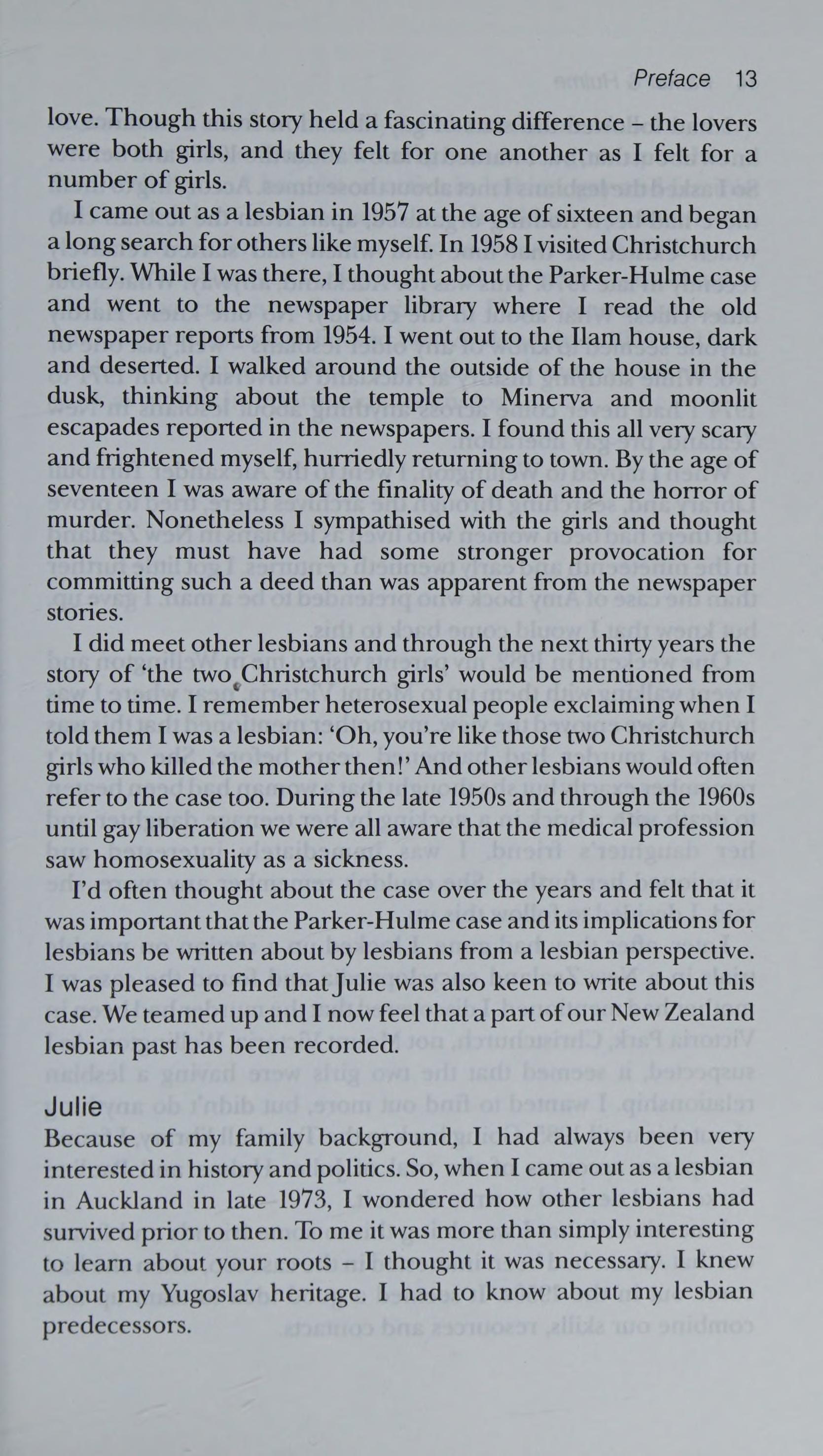 This brings the historical paradox to its most profound realization: the writing of the groundbreaking 1991 book Parker & Hulme: A Lesbian View. When Dr. Alison Laurie teamed up with Julie Glamuzina in the late 1980s to research and pen this text, they obtained highly guarded, confidential documents from the New Zealand Justice Department to trace the aftermath of the trial. It was during this investigative process that a staggering realization must have occurred.
As Laurie reviewed the government archives tracking the post-prison identities, state-mandated aliases, and UK migration files of the two women, she would have looked at the official paperwork for "Pauline Parker." There, stamped in the official record, was her new legal identity: Hilary Nathan.
For Laurie, the revelation would have been seismic. The woman whose historic teenage crime had cast a forty-year shadow over the New Zealand lesbian community—the very case that heterosexuals weaponized against Laurie when she came out in 1957—was not an abstract historical figure. She was "Hilary," the quiet, fiercely private expatriate who had shared the tiny Auckland circle of twenty-five women in the winter of 1964. She was the very same woman who had stepped up to chair Kenric in London in 1966.
True to the ironclad, protective code of the 1960s underground that formed them both, Laurie kept the secret. When A Lesbian View was published in 1991, it intentionally protected Nathan's anonymity, choosing to analyze the systemic homophobia of the 1954 trial rather than expose a contemporary peer. It was only years later, in the winter of 1996, that mainstream tabloid journalists methodically traced the paper trail to Kent and aggressively unmasked Nathan to the world.
The strange case of Alison J. Laurie and Hilary Nathan is more than a historical coincidence. It is a testament to the profound power, resilience, and absolute discretion of an early generation of queer women. In a hostile world, the transnational pipeline did not just offer escape—it provided the ultimate sanctuary, proving that even a woman carrying one of the dark secrets of the century could be quietly integrated, protected, and allowed to spend her life redeeming herself through service to others.
And there you have it, the strange case of Alison J. Laurie and Hilary Nathan untangled.
[back to top]
[back to top]
Sources:
- Lesbians on the loose.Vol. 8 No. 2 (February 1997)
- Parker and Hulme - a lesbian view (1992)
- Article 'FROM KAMP GIRLS TO POLITICAL DYKES' by Alison Laurie, as published in:
Broadsheet - New Zealand feminist magazine - 1985 November Issue 134
Broadsheet - New Zealand feminist magazine - 1985 December Issue 135 - Peter Graham, 'Anne Perry and the Murder of the Century' originally published as 'So Brilliantly Clever', 2011
- https://en.wikipedia.org/wiki/Kenric
- https://kenriclesbians.org.uk/about-kenric/the-first-treasurer/
More...
More will follow ...